Invariant Environment: Encountering the Unremembered Other is an XR-based artistic research project that explores bodily perception, spatial invariance, and encounters with others through haptic interaction. Grounded in neurodiversity-informed first-person research, the work draws on sensory and cognitive characteristics associated with autism spectrum conditions, including a preference for environmental stability and the difficulty of forming stable memories of unfamiliar faces.
The system integrates a head-mounted display (HMD) with a wearable haptic vest to create an immersive environment based on scans of a real physical space. The scanned room is reconstructed as an invariant XR environment in which spatial relationships are preserved while temporal change is excluded. Sculptural objects are spatially aligned with their physical counterparts, and contact with virtual objects generates localized haptic feedback via vibration actuators.
By maintaining a stable and predictable environment, the work foregrounds subtle bodily sensations and perceptual shifts. Within this setting, participants encounter others whose faces remain ambiguous and unfixed, revealing alternative modes of interaction between memorized space, bodily sensation, and the presence of others. The project proposes environmental invariance as an aesthetic framework for rethinking sensory diversity and embodied encounters.
This study explores the primordial sensory experience of humans by re-living the experience of having the body and mind of a baby. This experience was achieved using virtual reality (VR) and by wearing a special membrane bodysuit.
We must not forget that in the real world that we live, there are people who perceive the environment in different ways.
We were all babies once, but it could be difficult to clearly recall sensations and experiences we have then. This is because our minds and bodies have changed as we developed.
We should reaffirm the fact that even the familiar sensory experiences of infants are difficult to recall.
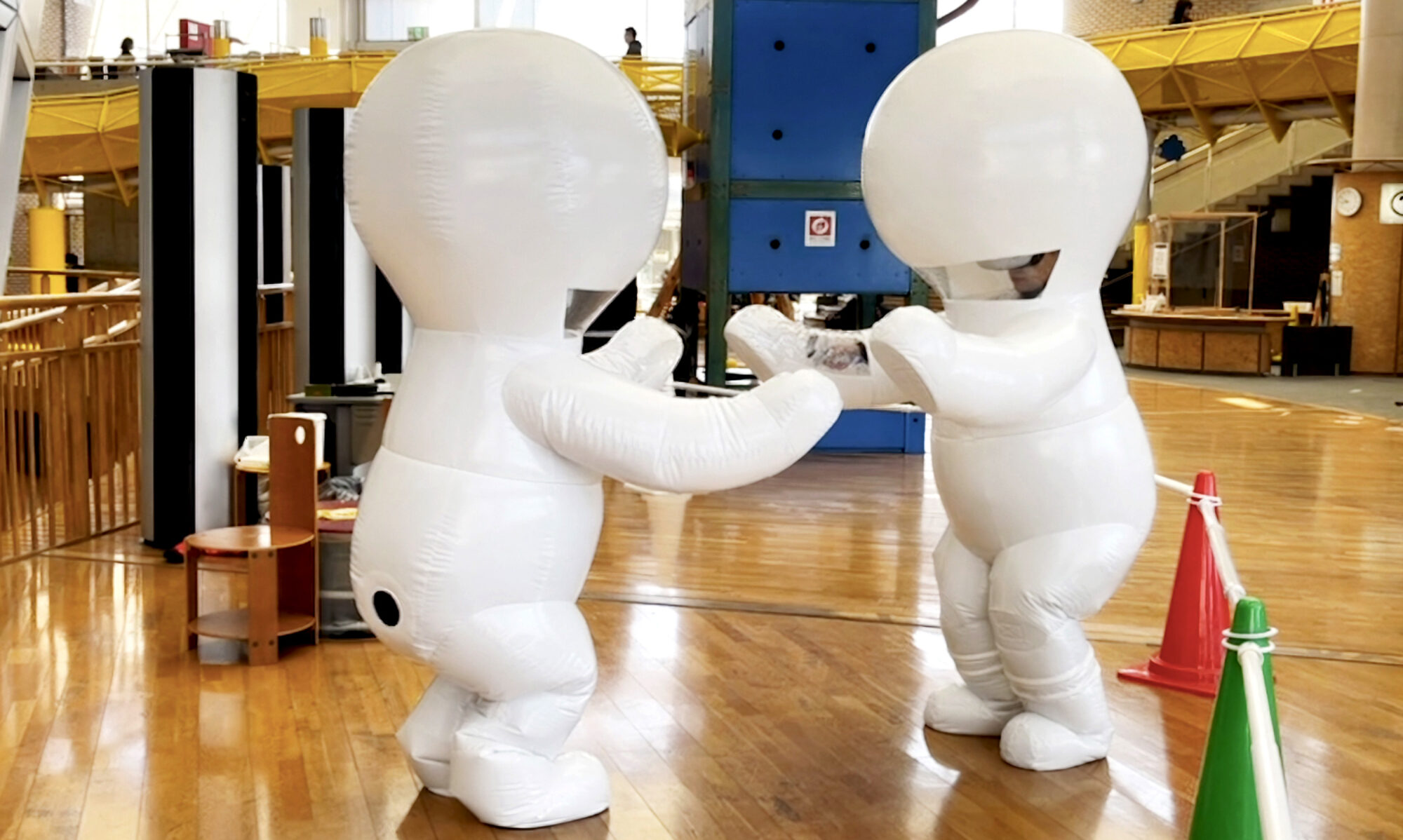
The method proposed in this study allows adults to re-experience having the mind and body of a baby. Using VR technology, this study reproduced a baby’s primordial sensory experiences. In addition, we developed a membrane structure using various modeling techniques to re-live the impact caused by differences in body proportions between a baby and an adult in terms of sensory experience.
Through this study, we hope to provide an experiential understanding of alternative sensory experiences of this world.